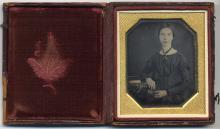
Mostrando las entradas con la etiqueta emily dickinson. Mostrar todas las entradas

lunes, julio 06, 2020

emily dickinson. como no pude detenerme ante la muerte


479

Como no pude detenerme ante la Muerte– 
Ella, amable, esperó por mí– 
El carruaje nos esperaba solo a Nosotros– 
Y a la Inmortalidad.

Avanzamos despacio – Ella no tenía apuro
Y yo debía guardar
Mi labor y mi ocio también,
Por su amabilidad– 

Pasamos por la Escuela, donde los Niños peleaban
En el Recreo – en el Círculo– 
Pasamos los Campos de Grano Maduro– 
Pasamos la Puesta del Sol– 

O más bien – Ella nos pasó a nosotros– 
Las Gotas de Rocío traían temblores y frío – 
Por todo vestido Gasa, era mi Traje–
Mi Estola – solo Tul– 

Nos detuvimos frente a una Casa que parecía
Una Protuberancia del suelo– 
El Techo apenas se veía– 
La Cornisa – a ras del Suelo– 

Desde entonces – son Siglos– y aun así
Se sienten más breves que el Día
En que comprendí que las Cabezas de los Caballos
Se dirigían hacia la Eternidad– 


Emily Dickinson, Amherst, Massachusetts, 1830- 1886
     En The Poems of Emily Dickinson, R. W. Franklin, Harvard University Press, 1999
     Versión © Silvia Camerotto

Because I could not stop for Death (479)

Because I could not stop for Death –
He kindly stopped for me –
The Carriage held but just Ourselves –
And Immortality.

We slowly drove – He knew no haste
And I had put away
My labor and my leisure too,
For His Civility – 

We passed the School, where Children strove
At Recess – in the Ring –
We passed the Fields of Gazing Grain –
We passed the Setting Sun – 

Or rather – He passed us –
The Dews drew quivering and chill –
For only Gossamer, my Gown –
My Tippet – only Tulle – 

We paused before a House that seemed
A Swelling of the Ground –
The Roof was scarcely visible –
The Cornice – in the Ground – 

Since then – 'tis Centuries – and yet
Feels shorter than the Day
I first surmised the Horses' Heads
Were toward Eternity – 

martes, julio 18, 2017

emily dickinson. tres versiones

Image result for emily dickinson


***
Nunca perdí más de dos veces,
y eso fue en la tierra.
¡Dos veces fui una mendiga
ante la puerta de Dios!

Los ángeles -descendieron dos veces
a devolverme mis bienes-
¡Ladrón! ¡Banquero! ¡Padre!
¡Soy pobre otra vez!

***
No soy Nadie. ¿Quién eres tu?
¿Eres tu Nadie, también?
¿Somos dos entonces?
¡No lo digas! Lo dirían, ¿sabes?

¡Qué deprimente es ser Alguien!
¡Qué vulgar-como una Rana-
diciendo nuestro nombre todo el día
a una ciénaga que aplaude!

***
El corazón pide Placer primero-
y después, ser dispensado del Dolor-
y después, esos calmantes
que matan el sufrimiento-

y después, irse a dormir,
y después, si ese fuera
el deseo de su Inquisidor,
el derecho a morir.

Emily Dickinson, Amherst, Massachussets, 1830-1886
Versiones © Silvia Camerotto
imagen de 


I never lost as much but twice
And that was in the sod.
Twice have I stood a beggar
Before the door of God!

Angels -twice descending,
Reimbursed my store-
Burglar! Banker! - Father!
I am poor once more!

***

I’m Nobody! Who are you?
Are you – Nobody – too?
Then there’s a pair of us!
Don’t tell! they’d advertise – you know!

How dreary – to be – Somebody!
How public – like a Frog – 
To tell one’s name – the livelong June – 
To an admiring Bog!


***
The heart asks Pleasure –first-
And then - Excuse from Pain-
And then - those little Anodynes
That deaden suffering-

And then -to go to sleep-
And then -if it should be
The will of its Inquisitor,
The privilege to die-


martes, junio 20, 2017

emily dickinson. me digo que la tierra es breve


***
Me digo que la tierra es breve,
y la angustia absoluta.
Que hay demasiado mal;
¿pero qué?

Me digo que podríamos morir;
que la más grande vitalidad
no puede vencer al crepúsculo;
¿pero qué?

Me digo que en el cielo
habrá de alguna manera un nivel,
habrá alguna nueva ecuación;
¿pero qué?


Emily Dickinson, Amherst, Massachussets, 1830-1886
en La asesina rubia, Antología poética, Traducción de Raúl Gustavo Aguirre, REUN, Libro Universitario Argentino, Buenos Aires, 2016

***
I reason, Earth is short-
And Anguish -absolute-
And many hurt,
But, what of that?

I reason, we could die -
The best Vitality
Cannot excel Decay,
But, what of that?

I reason, that in Heaven-
Somehow, it will be even -
Some new Equation, given -
But, what of that?

sábado, junio 03, 2017

emily dickinson. el dolor es

Image result for dickinson pain

***

El dolor es un elemento del vacío;
no puede recordar
cuándo comenzó, o dónde estuvo
el día en que no fue.

No tiene otra mañana más que él,
su reino infinito contiene
su ayer, iluminado para conocer
nuevos períodos de dolor.

Emily Dickinson, Amherst, Massachussets, 1830-1886
en La asesina rubia, Antología poética, Traducción de Raúl Gustavo Aguirre, REUN, Libro Universitario Argentino, Buenos Aires, 2016

***
Pain -has an Element of Blank-
It cannot recollect
When it begun -or if there were
A time when it was not-

It has no future -but itself-
Its infinite contain
Its Past -enlightened to perceive
New Periods -of Pain.

viernes, marzo 03, 2017

emily dickinson. wild nights


       269

       Salvajes noches – ¡Salvajes noches!
       Si contigo estuviese
      ¡Salvajes noche deberían ser
       Nuestro lujo!

      Fútiles –los vientos-
      Para un corazón en puerto-
      Basta de Brújulas-
      Basta de Mapas!

      Remando en el Edén-
     ¡Oh- el Mar!
     ¡Pueda yo anclar –esta noche-
      En ti!

     Emily Dickinson, Amherst, Massachusetts, 1830- 1886
     En The Poems of Emily Dickinson, R. W. Franklin, Harvard University Press, 1999
     Versión © Silvia Camerotto

     269

    Wild nights - Wild nights! 
    Were I with thee 
    Wild nights should be 
    Our luxury! 

     Futile - the winds - 
     To a Heart in port - 
     Done with the Compass - 
     Done with the Chart! 

     Rowing in Eden - 
     Ah - the Sea! 
     Might I but moor - tonight - 
     In thee! 


miércoles, diciembre 14, 2016

emily dickinson. después de un gran dolor


Después de un gran dolor, llega el  sentimiento racional,
Los Nervios quedan rígidos como Tumbas,
El Corazón endurecido se pregunta: ¿fue Él  quien soportó?
Y ¿fue Ayer o hace Siglos?

Los pies, mecánicamente, dan vueltas
Por la Tierra, o el Aire, o Nada,
Un camino de Madera
Cultivado con descuido,
Una paz interior de Cuarzo, como una piedra.

Esta es la hora del Plomo,
Recordado si se lo sobrevive,
Como las personas Congeladas que recuerdan la Nieve,
Primero Escalofrío, después Estupor, después dejarse ir.

c.1862

Emily Dickinson, Amherst, Massachusetts, 1830-1886
en The Poems of Emily Dickinson, editado por R. W. Franklin, Harvard University Press, 1999
Versión © Silvia Camerotto


After a great pain, a formal feeling comes –
The Nerves sit ceremonious, like, Tombs –
The stiff Heart questions was it He, that bore,
And Yesterday, or Centuries before?

The Feet, mechanical, go round –
Of Ground, or Air, or Ought –
A Wooden way
Regardless grown,
A Quartz contentment, like a stone –

This is the Hour of Lead –
Remembered, if outlived,
As Freezing persons, recollect the Snow –
First – Chill – then Stupor – then the letting go –

c. 1862


domingo, noviembre 01, 2015

emily dickinson. XXI. de las preciadas palabras


XXI

De las preciadas palabras comió y bebió,
Fortaleció su espíritu;
Y ya no supo que era pobre,
Ni que su cuerpo polvo era-

Bailó en los días sórdidos 
Y su alada herencia
Fue nada más un libro- la libertad
Que el espíritu libre da-

Emily Dickinson, Amherst, Massachusetts, 1830-1886
en The Poems of Emily Dickinson, editado por R. W. Franklin, Harvard University Press, 1999
Versión © Silvia Camerotto
imagen de Emily Dickinson Photograph: ©Amherst College Archives and Special Collections  


XXI

He ate and drank the precious words,
His spirit grew robust;
He knew no more that he was poor,
Nor that his frame was dust-

He danced along the dingy days,
And this bequest of wings
Was but a book -what liberty
A loosened spirit brings-


jueves, octubre 01, 2015

emily dickinson. nunca me sentí en casa


413

Nunca me sentí en casa –aquí abajo –.
Y en los cielos radiantes
no me sentiré en casa –lo sé–
no me gusta el Paraíso–

Porque es domingo –todo el tiempo–
y el receso –nunca llega–
y en el Edén serán tan solitarias
las radiantes tardes de miércoles–

Si Dios pudiera visitarnos–
o hacer alguna vez la siesta–
para no vernos–pero dicen
que él mismo– es un telescopio

que nos observa perenne–
yo misma huiría
de él–y Santo Cielo–y de todo
¡pero está el Juicio Final!

Emily Dickinson, Amherst, 1830- 1886
versión © Silvia Camerotto
imagen s/d

413

I never felt at Home—Below—-
And in the Handsome Skies
I shall not feel at Home—I know—
I don't like Paradise—

Because it's Sunday—all the time—
And Recess—never comes—
And Eden'll be so lonesome
Bright Wednesday Afternoons—

If God could make a visit—
Or ever took a Nap—
So not to see us—but they say
Himself—a Telescope

Perennial beholds us—
Myself would run away
From Him—and Holy Ghost—and All—
But there's the "Judgement Day"!

martes, mayo 05, 2015

emily dickinson. haz amplia esta cama


Poema 829

Haz amplia esta cama.
Haz esta cama con respeto;
en ella espera hasta que el juicio se revele
superior y justo.

Sea su colchón recto,
sea su almohada redonda;
nadie permita que el ruido amarillo del alba
perturbe este suelo.

Emily Dickinson, Amherst, 1830- 1886
versión © Silvia Camerotto
imagen en izquotes.com

Poem 829

Ample make this bed.
Make this bed with awe;
In it wait till judgment break
Excellent and fair.

Be its mattress straight,
Be its pillow round;
Let no sunrise' yellow noise
Interrupt this ground.


viernes, abril 18, 2014

emily dickinson. es la dicha tal abismo...


CXXXV

¿Es la dicha tal Abismo
por lo tanto no debo
dar un paso en falso
por temor a arruinar los zapatos?

Prefiero acomodar mis pies
a cuidar mis zapatos—
porque comprar otro Par
se puede
en cualquier tienda—

Pero la dicha se entrega solo una vez.
Perdida la Patente
nadie podrá comprarla nunca más—
Entonces, pies, decidan la cuestión—
¿debe cruzar la señorita, o no?
¡Pronúnciense, Zapatos!


Emily Dickinson, Amherst, Massachusetts, 1830-1886
en The Poems of Emily Dickinson, editado por R. W. Franklin, Harvard University Press, 1999
Versión © Silvia Camerotto
imagen de ©  Jacqui Faye en Red Shoes Dailies

CXXXV

Is Bliss then, such Abyss,
I must not put my foot amiss
For fear I spoil my shoe?

I'd rather suit my foot
Than save my Boot —
For yet to buy another Pair
Is possible,
At any store —

But Bliss, is sold just once.
The Patent lost
None buy it any more —
Say, Foot, decide the point —
The Lady cross, or not?
Verdict for Boot!

lunes, abril 14, 2014

emily dickinson. cuando cuento las semillas


40

Cuando cuento las semillas
sembradas debajo,
floreciendo así, tarde o temprano—

Cuando estudio a la gente
cayendo tan bajo
llegando  tan alto—

Cuando sé que los mortales
no verán el  jardín—
eligiendo sus flores por la fe
y evitando su Abeja,
puedo prescindir del verano, con ganas.

Emily Dickinson, Amherst, Massachusetts, 1830-1886
en The Poems of Emily Dickinson, editado por R. W. Franklin, Harvard University Press, 1999
Versión © Silvia Camerotto
imagen de John Kirk en Victoriana

40

When I count the seeds
That are sown beneath,
To bloom so, bye and bye—

When I con the people
Lain so low,
To be received as high—

When I believe the garden
Mortal shall not see—
Pick by faith its blossom
And avoid its Bee,
I can spare this summer, unreluctantly. 


miércoles, febrero 26, 2014

emily dickinson. certeza


Certeza

Jamás he visto un páramo
Jamás he visto el mar;
Y aun así sé como es el brezo
Y cómo la ola es.

Jamás hablé con Dios,
Ni  lo visité en el cielo;
Pero tengo la certeza del lugar
Como si me tuviera el mapa.

Emily Dickinson, Amherst, Massachusetts, 1830-1886
en The Poems of Emily Dickinson, editado por R. W. Franklin, Harvard University Press, 1999
Versión © Silvia Camerotto
imagen de Dominant Star

Certainty

I never saw a moor,
I never saw the sea;
Yet know I how the heather looks,
And what a wave must be.

I never spoke with God,
Nor visited in heaven;
Yet certain am I of the spot
As if the chart were given.


jueves, enero 23, 2014

emily dickinson. sin ver, aún sabemos


1518

Sin ver, aún sabemos —
Sin saber, suponemos —
Sin suponer, sonreímos y ocultamos
y acariciamos a medias —

y temblamos — y huimos,
seráfico miedo —
¿Insinúa el Paraíso
“si te atreves”?

Emily Dickinson, Amherst, Massachusetts, 1830-1886
en The Poems of Emily Dickinson, editado por R. W. Franklin, Harvard University Press, 1999
Versión © Silvia Camerotto
imagen de Hieronymus Bosch ©,

1518


Not seeing, still we know —
Not knowing, guess —
Not guessing, smile and hide
And half caress —

And quake — and turn away,
Seraphic fear —
Is Eden's innuendo
"If you dare"?

viernes, abril 12, 2013

emily dickinson. el misterio del dolor


El misterio del dolor

El dolor tiene un elemento en blanco;
no puede recordar
cuándo empezó, o si hubo
algún día que no estuviera.

No tiene futuro sino el propio,
sus reinos infinitos contienen
su pasado, iluminados para percibir
nuevos períodos de dolor.

Emily Dickinson, Amherst, Massachusetts, 1830-1886
en The Poems of Emily Dickinson, editado por R. W. Franklin, Harvard University Press, 1999
Versión © Silvia Camerotto
imagen de Anka Zhuravleva ©, Breathe in Breath out, en Uno de los nuestros

The Mystery of Pain

Pain has an element of blank;
It cannot recollect
When it began, or if there were
A day when it was not.

It has no future but itself,
Its infinite realms contain
Its past, enlightened to perceive
New periods of pain.

martes, junio 26, 2012

emily dickinson. nunca sabemos que vamos


CXXXI

Nunca sabemos que vamos, cuando estamos yendo
bromeamos y cerramos la puerta;
el destino que nos sigue le pone el pasador,
y no avanzamos  más.

Emily Dickinson, Amherst, Massachusetts, 1830-1886
en The Poems of Emily Dickinson, editado por R. W. Franklin, Harvard University Press, 1999
Versión © Silvia Camerotto
imagen de Francesca Woodman©, en Uno de los nuestros

CXXXI

We never know we go, — when we are going
We jest and shut the door;
Fate following behind us bolts it,
And we accost no more.

miércoles, mayo 30, 2012

emily dickinson. si ellos han olvidado y otro


**
1329

Si ellos han olvidado
O están olvidando ahora
O jamás recordaron—
Mejor es no saber—

Las desdichas de las conjeturas
Son una pena más leve
Que una verdad de hierro
Endurecida con un Yo sé—

c. 1874


**
1350

La suerte no es azar—
Es trabajo duro—
La onerosa sonrisa de la fortuna
Se gana—
El señor de la mina
Es esa antigua moneda
Que despreciamos—

c. 1875

Emily Dickinson, Amherst, Massachusetts, 1830-1886
en The Poems of Emily Dickinson, editado por R. W. Franklin, Harvard University Press, 1999
Versión © Silvia Camerotto
imagen de Jamie Baldridge©, A Ten-Penny Prophet, en Uno de los nuestros

**
1329

Whether they have forgotten
Or are forgetting now
Or never remembered—
Safer not to know—

Miseries of conjecture
Are a softer woe
Than a Fact of Iron
Hardened with I know—


**
1350

Luck is not chance—
It’s Toil—
Fortune’s expensive smile
Is earned—
The Father of the Mine
Is that old-fashioned Coin
We spurned—

domingo, enero 01, 2012

ladies first


***
De 2 a 5 de la mañana no duermo


cuando por desgracia estoy en mi cama a esa hora
no duermo
excelente momento
en el corazón de la noche
para escucharla
y escuchar sobre todo a los que se fueron
a los que no vuelven
a los que combato
nunca pienso en los amigos
jamás pensé en las cosas seguras
no escucho las maravillas del maestro rubén
no hay carruajes a veces hay un ascensor
pero recuerdo tanto
escenifico respuestas desprecios que ejerceré
pienso cómo luchar
espero el ruido del avión de las cinco y media de la mañana
me duermo como si fuera en los aviones que amé
y ya se han acabado
pienso que en ese silencio
alguien estará escribiendo la gran poesía de mi ciudad
escribiendo a solas como yo escribía en Saavedra
imagen oculta de esa muchacha que fui
ahora visita de la madrugada
pienso en esa persona desconocida
luchando por salir de un universo de horizonte cerrado
y escribiendo escribiendo y con sus palabras
letra a letra ganando para siempre una guerra

Juana Bignozzi, Buenos Aires, 1937
en Si alguien tiene que ser después, Adriana Hidalgo Editora, Buenos Aires, 2010

***
After a great pain


After a great pain, a formal feeling comes—
The Nerves sit ceremonious, like Tombs—
The stiff Heart questions was it He, that bore,
and Yesterday, or Centuries before?

The Feet, mechanical, go round—
Of Ground, or Air, or Ought—
A Wooden way
Regardless grown,
A Quartz contentment, like a stone—

This is the Hour of Lead—
Remembered, if outlived,
As Freezing persons, recollect the Snow—
First— Chill — then Stupor— then the letting go—

Emily Dickinson, Amherst, Massachusetts, 1830-1886
en The Poems of Emily Dickinson, editado por R. W. Franklin, Harvard University Press, 1999

***
Llueve como si no bastara...


Llueve como si no bastara,
como si un anhelo fuera demasiado poco,
demasiado lo que no alcanza o lo que llueve: bastante,
suficiente.
No alcanza un anhelo, hace falta
más y más de esa nada que sobra, como la lluvia que sobra, arrebata
el borde del postigo y cae
hacia adentro, moja los libros dejados al azar
bien en el borde, sin cuidado,
se corre la tinta en cada uno, demasiado,
demasiado perder lo que no basta,
la lluvia como si no sostuviera el cielo.

Irene Gruss, Buenos Aires, 1950
Inédito

***
A graveyard


Man, looking into the sea—
taking the view from those who have as much right to it as you have it to yourself—
it is human nature to stand in the middle of a thing
but you cannot stand in the middle of this:
the sea has nothing to give but a well excavated grave.
The firs stand in a procession—each with an emerald turkey-foot at the top—
reserved as their contours, saying nothing;
repression, however, is not the most obvious characteristic of the sea;
the sea is a collector, quick to return a rapacious look.
There are others besides you who have worn that look—
whose expression is no longer a protest; the fish no longer investigate them
for their bones have not lasted;
men lower nets, unconscious of the fact that they are desecrating a grave,
and row quickly away—the blades of the oars
moving together like the feet of water-spiders as if there were no such thing as death.
The wrinkles progress upon themselves in a phalanx—beautiful under networks of foam,
and fade breathlessly while the sea rustles in and out of the seaweed;
the birds swim through the air at top speed, emitting cat-calls as heretofore—
the tortoise-shell scourges about the feet of the cliffs, in motion beneath them
and the ocean, under the pulsation of light-houses and noise of bell-buoys,
advances as usual, looking as if it were not that ocean in which dropped things are bound to sink—
in which if they turn and twist, it is neither with volition nor consciousness.

Marianne Moore, Kirkwood, 1887 - Nueva York, 1972
en Becoming Marianne Moore: The Early Poems 1907-1924, University of California Press, 2002

imagen de Fredrik Ödman©, The Creation Serie, en Uno de los nuestros